CRM Architecture: Your Tools Are Not the Problem
Most CRM problems are architecture problems, not tool problems. The systems model we use to design a CRM that actually holds the truth.
In shortMost CRM problems are architecture problems, not tool problems. Architecture is the design of how your systems fit together: what each system is for, how they connect, the steps inside each one, and who is involved at each step. Get that right and the tool is an implementation detail. Get it wrong and no tool saves you.
 Oriol SerraAug 10, 2026 · 8 min read


Most companies do not have a CRM. They have a data exhaust pipe. Records go in, nobody agrees on what they mean, and six months later the pipeline number in the board deck is a guess wearing a suit. When that happens, the reflex is always the same: blame the tool. The CRM is clunky, HubSpot is limiting, we picked the wrong platform, let's migrate. So they migrate, and the mess simply moves house. Same chaos, new logo on the login screen.
Here is what almost nobody selling you software will say out loud. Your CRM is rarely the problem. Your architecture is. And architecture is not a tool. It is the design of how your systems fit together.
What "architecture" actually means
We named the company Architects on purpose. Companies do not buy a CRM from us. They buy the design of how their systems fit together. That design comes down to four questions:
- What systems exist, and what each one is actually for.
- How they connect to each other.
- What the steps are inside each system, in order.
- Which people and teams are involved at each step.
Answer those four honestly and the tool becomes an implementation detail. Get them wrong and no tool saves you. This is the line that separates us from HubSpot partners, lead gen agencies and ERP integrators. They sell a tool and inherit whatever architecture you already had. We are not married to any tool: Clay, HubSpot, SAP, whatever comes next. The architecture decides, not the vendor.
Picture the company as a building
The clearest way to see your own operation is to draw it as a building seen from above, then cut through it. Four levels.
Level 01, the teams
Marketing, sales, customer success, production, finance. Each occupies its own floor and does its own work.
Level minus 01, the human channel
Slack, email, meetings, the hallway. This is where people talk to each other. It is real, it is necessary, and it is where almost everyone believes the company actually runs.
Level 02, the systems
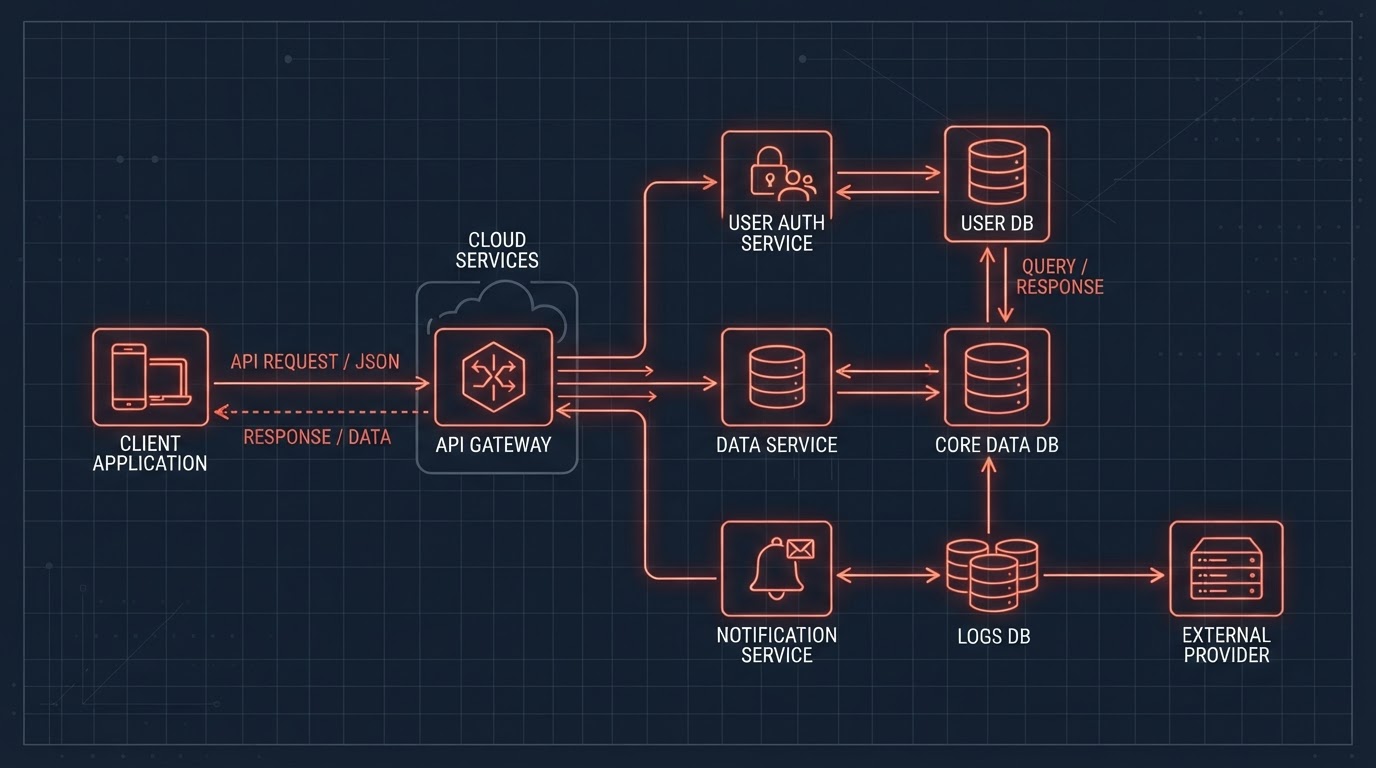
CRM, production database, ticketing, billing or ERP. This is where machines talk to each other. Records move here.
Level 03, the master record
Where it exists, a database sitting above the systems that holds the authoritative version of the truth. Systems sync up to it and down from it, so when something happens in the real world it lands in one place and propagates everywhere else.
Now the whole point. Teams push and pull vertically into their own system. Systems talk sideways to each other. People talk sideways to each other. Nothing crosses between the human layer and the machine layer on its own.
That gap is the failure. When sales and marketing need to coordinate, they do it in the human channel, which feels like communication and produces no record. The machines above them never learn that anything happened. Marketing runs a campaign, sales cannot see which leads came from it, and two quarters later nobody can forecast because the evidence of what actually happened lived and died in a Slack thread. Say it plainly: a conversation is not a record.
The mistake that quietly kills reporting
Every dashboard you will ever want is downstream of one thing: did the events that matter get written to the machine layer? If they did not, you are reconstructing history from memory, and memory does not sum. This is why "just build me a better report" is almost always the wrong ask. The hard part is never the report. It is the data and the logic that power it.
The bleed is real money. Leads that never get routed, deals that stall because nobody owns them, forecasts that miss by enough to blow a hiring plan. Every CRM decays silently, and we quantify that decay as revenue at risk per month. It is almost never a tool line item. It is architecture, showing up on the P&L.
Which system serves which team
One rule prevents most of the mess: the CRM serves the commercial teams only. Marketing, sales, customer success. It holds what relates to customers, and nothing else.
Production does not belong in the CRM and should never be forced into it. It runs on its own database: raw materials in stock, purchases made, units shipped this month. That data has no business in a CRM because it is not about a customer. The two systems are joined by IDs, not by duplication. Product 85421 was sold to customer 248. That handshake is the join, and getting it right is most of the work in any industrial account.
We built exactly this for Elesa and Ganter, an industrial manufacturer running HubSpot next to SAP: ticket routing and ownership by zone and postal code, SLA and escalation logic, phone numbers normalized to a single standard, and a clean write-back to SAP so the two systems stayed in sync instead of fighting each other. The outcome is not "a nicer CRM." It is two systems that finally agree on who bought what.
Identity is the foundation, not a setting
Before any record moves, you decide what a record is and which field is the source of truth. We call this the identity hierarchy, and in a SaaS account it usually runs Stripe, then Tenant, then Domain, then Name, in that order of trust. It sounds academic until you watch a company try to add up its own revenue and discover three things at once: a registration_email and a billing_email that point at two different "customers," a Tenant ID and a Stripe Customer ID that were never reconciled, and deal revenue stored as text instead of numbers, so it cannot be summed at all. None of those are tool bugs. They are architecture decisions that were never made.
This is why every build we run has a hard gate called Client Approval on Data Model before a single workflow gets wired. You approve the identity rules, the objects and how they relate, on a flowchart, in plain language, before we touch anything. Skipping that gate is how you get a very fast build of the wrong thing.
Where AI and Clay actually fit
Teams see Clay or an AI agent and assume it is a new architecture. It is not. It is a new occupant of an existing one. Clay sits next to the CRM at the systems level and absorbs the manual tasks the commercial teams used to do by hand: enrichment, list building, scoring. Those tasks leave the human floor and become an adjacent system. The shape of the building does not change. Saying this out loud saves clients from the most expensive mistake in the current market, which is buying tools to paper over an architecture nobody ever drew.
Migration is an operating-system problem
Lift and shift copies the mess into a new house. A migration is an operating-system problem, not a data-transfer problem. When we moved Tech Barcelona from Zoho to HubSpot, a build touching up to fifty thousand records, we did not "export and import." We redesigned the data model first, ran the cutover in phases, and wrapped governance and QA sign-off around it, because the goal was never to relocate the data. It was to change what the data means going forward. If you migrate without redoing the architecture, you have paid to reproduce your old problems in a more expensive editor.
How to audit your own architecture in ten minutes
Do not go looking for "our architecture." Almost nobody, including directors, knows the word in this sense, and asking makes people feel stupid. Ask a simpler question: what is your commercial process? A head of sales who cannot answer that is a painter who cannot name their paint, and the fumbling itself is the first diagnostic.
Then walk it, step by step, and mark every break:
- Where do the leads come from?
- Who picks them up, and how? ("She googles them" is manual. Mark it.)
- How are they enriched? ("They are not." Mark it.)
- How do you score them, and how do you know something is ICP? ("We do not." Mark it.)
- What happens after the meeting, and where does it get recorded?
- If marketing runs something, where does sales see it?
- How do you forecast next year?
That last question is the killer, especially in established companies doing 70 to 120 million in revenue. The answer is almost always some version of "more or less, by what clients tell us they will order, and they keep it written down somewhere." Every "mark it" is a point where the human layer and the machine layer failed to connect. Count them. That total is your architecture, whether you designed it or not.
The reframe
A CRM tells you what is happening. It does not make anyone better at selling, and it will not design itself. The tool you buy is the last decision, not the first. Decide what your systems are for, how they connect, and where the truth lives. Then pick software to match. Do it in that order and the platform argument mostly disappears, because any competent tool can hold a good architecture and no tool can rescue a bad one.
If you already suspect the wiring under your CRM is the real problem, that is exactly what our CRM Foundation and Data Architecture work is built for. We draw the building before we build it, get your sign-off on the data model, then wire the systems so the truth lands in one place and propagates. Start with your commercial process. Everything worth reporting on is downstream of getting that on paper.